
How a Tankless Water Heater Can Save You Money on Energy Bills
Hot water is something most homeowners use every day without thinking much about what it costs. Showers, dishwashers, washing machines, sinks, and other household activities can all require heated water, making the water heater an important part of a home’s overall energy use.
Traditional tank-style water heaters keep a supply of hot water ready around the clock. While this provides convenient access to hot water, it also means energy may be used maintaining the temperature of stored water even when nobody is using it.
A tankless water heater works differently. Instead of storing a large amount of heated water, it heats water as it’s needed. For the right household, that difference can reduce energy consumption and potentially lower monthly utility costs.
At Service Pro Plumbing, we help homeowners throughout Vancouver, Camas, Battle Ground, Kelso, and Southwest Washington evaluate water heater options based on their home’s plumbing, hot-water demands, available utilities, and budget. Here’s how switching to a tankless water heater could affect your home’s energy costs.
How Does a Tankless Water Heater Work?
A traditional water heater typically stores dozens of gallons of heated water inside an insulated tank.
As the water inside the tank cools, the unit periodically uses energy to bring it back to the desired temperature. This can occur whether you’re actively using hot water or not.
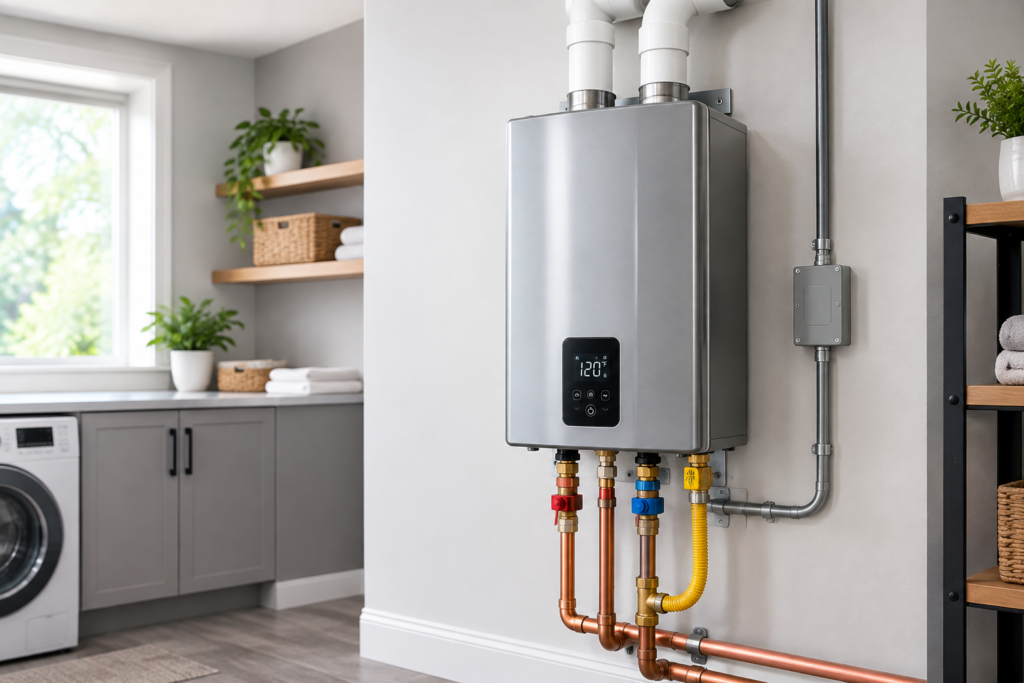
Tankless water heaters eliminate the storage tank.
When you turn on a hot-water fixture, water flows through the tankless unit. A gas burner or electric heating element heats the water as it passes through the system. When you turn the fixture off, the heating process stops.
This is why tankless systems are frequently referred to as on-demand water heaters.
By heating water when it’s required instead of maintaining a large stored supply, tankless systems can reduce what’s commonly called standby energy loss.
Eliminating Standby Energy Loss
One of the primary energy-saving advantages of a tankless water heater is the reduction of standby losses.
Imagine heating a large pot of water and trying to keep it hot throughout the entire day. Even if the container is well insulated, some heat will gradually escape, requiring additional energy to maintain the desired temperature.
A storage water heater faces a similar challenge.
Modern tank water heaters use insulation to reduce heat loss, but the system still needs to maintain the stored water at the selected temperature.
A tankless water heater in Vancouver, WA, on the other hand, doesn’t need to continuously maintain a tank full of hot water.
Over months and years of operation, reducing standby energy use can contribute to lower household energy consumption.
How Much Energy Can a Tankless Water Heater Save?
Actual savings depend heavily on household hot-water use, fuel type, equipment efficiency, local utility rates, and the water heater being replaced.
According to the U.S. Department of Energy, for homes that use 41 gallons or less of hot water per day, demand water heaters can be approximately 24% to 34% more energy efficient than conventional storage-tank water heaters. In homes that use around 86 gallons per day, they can be approximately 8% to 14% more energy efficient.
Those percentages don’t mean your total utility bill will automatically decrease by the same amount. They refer specifically to water-heating efficiency under those usage scenarios.
Still, water heating represents a meaningful household expense, so improved efficiency can create long-term savings.
Lower Energy Use Doesn't Always Mean Immediate Savings
It’s important to look at the complete financial picture.
Tankless water heaters generally cost more upfront than basic storage-tank models.
Installation can also require modifications to the home’s existing plumbing, gas supply, electrical service, venting, or other components depending on the system being installed.
That means the energy savings shouldn’t be viewed in isolation.
When considering a tankless water heater installation in Vancouver, Washington, homeowners should compare the expected operating costs, installation price, equipment lifespan, maintenance needs, and their household’s hot-water usage.
The best financial choice can be different from one home to another.
Tankless Water Heaters Can Have a Longer Service Life
Another factor that can influence long-term cost is equipment lifespan.
The U.S. Department of Energy notes that tankless water heaters can have a life expectancy of more than 20 years, while storage water heaters generally have a shorter expected service life.
Many tankless systems also have replaceable components that can potentially extend their usable life when properly maintained.
That doesn’t mean every tankless unit will automatically last 20 years. Water quality, installation, usage, maintenance, and equipment quality can all influence lifespan.
However, homeowners comparing the long-term cost of a tankless system with a traditional water heater should consider how frequently each type of equipment may need to be replaced.
You Aren't Paying to Heat Water While You're Away
Tankless systems can make particular sense for households that don’t need hot water continuously.
If your home sits empty while everyone is at work or school, a storage water heater may still periodically maintain its tank temperature.
The same can occur overnight or while you’re away from home.
Tankless equipment only operates in response to hot-water demand.
For some households, this can make the system’s energy use better aligned with when hot water is actually being consumed.
For homeowners interested in energy-efficient water heaters in Southwest Washington, that on-demand operation is one of the main reasons to consider going tankless.
Tankless Doesn't Mean Unlimited Hot Water in Every Situation
You’ll sometimes hear tankless water heaters described as providing “unlimited hot water.”
That description needs some context.
A properly sized tankless system can continue heating water as long as the required flow remains within the unit’s capabilities. Unlike a tank water heater, it doesn’t simply run out of stored hot water after the tank has been depleted.
However, every tankless water heater has a maximum heating capacity.
If several showers, sinks, appliances, or other fixtures demand hot water simultaneously, the combined flow could exceed what an undersized unit can effectively supply.
That’s why proper tankless water heater sizing is extremely important.
Choosing the Right Size Can Affect Performance and Efficiency
Buying the biggest tankless water heater available isn’t necessarily the right answer.
The system should be selected based on your household’s expected hot-water demand and the amount of temperature rise required.
A plumber may consider factors such as the number of bathrooms, household size, showers, tubs, dishwasher use, washing machine use, and the likelihood that multiple hot-water fixtures will operate simultaneously.
Incoming water temperature also matters because the heater needs to raise that water to the desired output temperature.
Professional sizing can help homeowners select a system capable of meeting their needs without unnecessarily oversizing the equipment.
For a tankless water heater installation in Camas or Vancouver, evaluating these factors before purchasing equipment can prevent disappointing performance later.
Gas vs. Electric Tankless Water Heaters
Tankless water heaters are available in both gas-fired and electric configurations.
Which one makes the most sense depends on the home.
Gas tankless systems are commonly selected for households with larger hot-water demands, but they may require appropriate gas-line capacity and venting.
Electric tankless systems don’t require combustion venting, but larger units can create significant electrical demand. Some homes may require electrical upgrades before an electric tankless system can be installed.
The cost of electricity and natural gas can also affect long-term operating expenses.
Instead of assuming one option is automatically cheaper, homeowners should evaluate the equipment alongside their home’s existing utilities and anticipated hot-water usage.
Space Savings Can Be an Added Benefit
Energy efficiency may be the primary motivation for switching, but tankless systems offer another advantage: size.
Traditional water heaters require enough floor space for a storage tank.
Tankless systems are much more compact and are generally mounted on a wall.
For homes where utility-room, garage, or closet space is limited, eliminating a large storage tank can free up useful room.
This can be especially appealing during a remodel where homeowners are trying to make better use of an existing floor plan.
Maintenance Matters
Tankless water heaters aren’t maintenance-free.
Minerals can accumulate inside the heat exchanger over time, particularly in areas with mineral-rich water. This buildup can reduce performance and potentially affect the equipment.
Depending on the unit, manufacturer recommendations, and water conditions, periodic flushing or descaling may be recommended.
Routine maintenance provides an opportunity to keep the system operating properly and address small concerns before they develop into larger problems.
If you’re investing in a tankless water heater in Battle Ground, Vancouver, Camas, or Kelso, following the manufacturer’s maintenance recommendations can help protect that investment.
When Does Switching to Tankless Make the Most Sense?
Not every homeowner needs to replace a functioning water heater simply to switch technologies.
The decision often makes the most financial sense when the existing water heater is already approaching replacement, the household plans to remain in the home long enough to benefit from energy savings, or the homeowner specifically values the additional benefits of a tankless system.
It may also be worth considering during a larger remodel or plumbing upgrade.
If your current tank water heater is already failing, comparing traditional and tankless replacement options before installing another tank can help you understand the long-term costs of each choice.
Signs Your Current Water Heater May Need Attention
If your existing water heater isn’t performing correctly, you may already be considering replacement.
Common signs that warrant professional evaluation include inconsistent hot water, visible leakage around the tank, unusual noises, rusty or discolored hot water, declining hot-water capacity, or a water heater that requires increasingly frequent repairs.
A problem doesn’t automatically mean replacement is necessary.
A plumber can inspect the equipment and help determine whether repair or replacement is the more practical option.
If replacement makes sense, that’s a good time to compare a conventional tank with a high-efficiency tankless water heater.
Think About Long-Term Cost, Not Just Purchase Price
One of the biggest mistakes homeowners can make when comparing water heaters is looking only at the price of the equipment.
The cheapest unit to purchase isn’t necessarily the least expensive unit to own.
A more complete comparison includes installation costs, expected energy consumption, maintenance requirements, equipment lifespan, available warranties, and anticipated replacement costs.
Tankless water heaters often require a larger initial investment, but their improved efficiency and potential for a longer service life can make them financially attractive for certain households.
The numbers will be different for every home.
Tankless Water Heater Installation in Vancouver and Southwest Washington
A tankless water heater can reduce the energy wasted keeping stored water hot around the clock. For households with appropriate hot-water demands, this can translate into lower water-heating energy consumption and potential savings over the life of the equipment.
But getting those benefits starts with choosing the right system.
The unit needs to be appropriately sized, compatible with the home’s gas or electrical infrastructure, correctly installed, and maintained according to manufacturer recommendations.
Service Pro Plumbing provides professional water heater and tankless water heater services throughout Vancouver, Camas, Battle Ground, Kelso, and surrounding Southwest Washington communities.
Whether your existing water heater has stopped working, you’re comparing tank vs. tankless water heaters, or you’re looking for a more energy-efficient way to provide hot water for your home, our team can help you evaluate your options.
Switching to tankless isn’t automatically the cheapest solution for every household. But when the system is properly selected for the home, the combination of reduced standby energy loss, improved efficiency, compact installation, and potentially longer equipment life can make a tankless water heater a smart long-term investment.
FAQ's
Yes, tankless systems can reduce standby energy loss by heating water only when it is needed. Actual savings depend on usage, fuel type, efficiency, and utility rates.
The article notes that demand water heaters can be about 24% to 34% more efficient for homes using 41 gallons or less daily. Higher-use homes may see smaller efficiency gains.
Usually, the initial investment can be higher than a traditional tank system. Installation may also require changes to plumbing, gas, electrical service, or venting.
Tankless water heaters can have a life expectancy of more than 20 years, according to the article. Proper installation, maintenance, water quality, and equipment quality can affect actual lifespan.